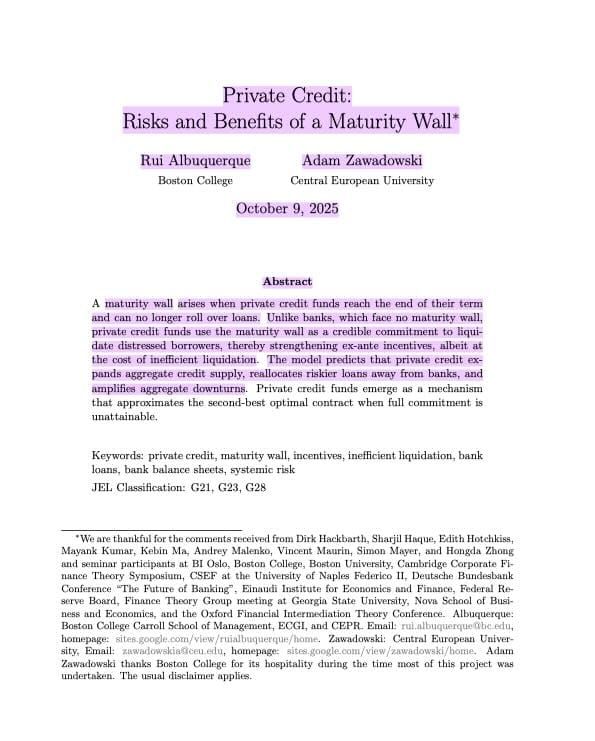
Source / Author: Rui Albuquerque (Boston College) and Adam Zawadowski (Central European University)
Publication Date: October 2025
Document with my annotations:
Focus:
The paper develops a theoretical model to explain how the limited lifetime of private credit funds—unlike banks’ perpetual structure—creates both disciplinary incentives for borrowers and systemic vulnerabilities during downturns. The “maturity wall” acts as a commitment device that strengthens borrower effort but can trigger inefficient liquidations when loans cannot be rolled over.
Key Insights
• Maturity walls arise because closed-end private credit funds cannot roll over loans, forcing liquidation when borrowers underperform.
• This commitment to terminate weak borrowers enhances ex-ante effort incentives, contrasting with banks’ tendency to renegotiate.
• Private credit funds expand the overall supply of credit, including to firms that banks would not fund (“democratization of credit”).
• They also engage in “business stealing”, attracting riskier borrowers from banks, which reduces bank balance-sheet size but may raise systemic cyclicality.
• The maturity wall amplifies aggregate downturns, as simultaneous fund liquidations can magnify losses.
• The structure approximates a second-best optimal contract, where finite fund life mimics an ideal commitment mechanism.
• Global private credit AUM (2023): USD 1.6 trillion (IMF 2024 cited in paper)
• Typical fund lifetime: 5–10 years
• Share of perpetual funds (BDCs) in U.S. market: ≈20%
Analyst Take
Albuquerque and Zawadowski provide a rigorous theoretical framework for understanding private credit’s dual role as discipline enforcer and amplifier of systemic risk. Their model elegantly formalizes why closed-end structures persist and how they shape borrower incentives, liquidity, and financial stability. For institutional investors and policymakers, the findings clarify that finite fund horizons both strengthen credit quality and heighten tail risk—a dynamic increasingly relevant as tokenization and on-chain credit markets adopt similar maturity constraints. The paper underscores the potential of programmable credit instruments and real-time transparency to offset the inefficiencies of the maturity wall.
Citation:
Source: National Bureau of Economic Research (NBER Working Paper No. 32456), “Private Credit: Risks and Benefits of a Maturity Wall,” October 2025.